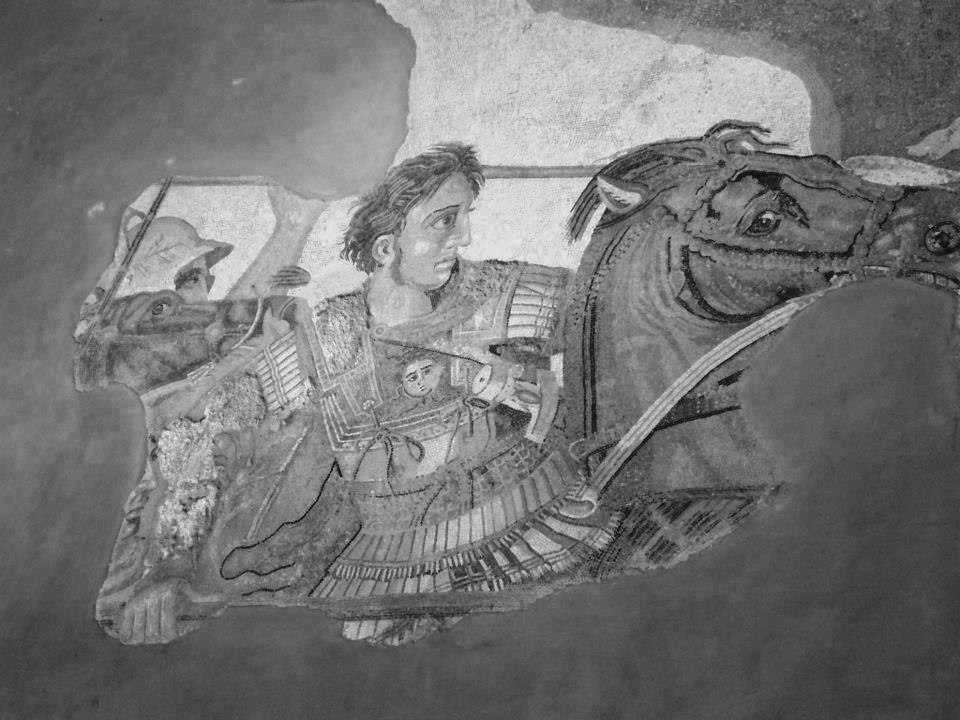
The Career of Alexander the Great – H.G. Wells

Synopsis:

In The Outline of History, H.G. Wells chronicles the metamorphosis of humanity from its earliest beginnings until the time of his own contemporary epoch. Wells maps the rise and decline of civilizations by describing the world historical individuals most influential at setting the course of society. His biography of Alexander the Great offers his own keen insights, and exhibits the intellectual dispositions of the era in which Wells lived.

Excerpts:

“Alexander was, as few other monarchs have ever been, a specially educated king; he was educated for empire. Aristotle was but one of the several able tutors his father chose for him. Philip confided his policy to him, and entrusted him with commands and authority by the time he was sixteen. He commanded the cavalry at Chaeronea under his father’s eye. He was nursed into power – generously and unsuspiciously. To any one who reads his life with care it is evident that Alexander started with an equipment of training and ideas of unprecedented value.

“The strong sanity he inherited from his father had made him a great soldier; the teaching of Aristotle had given him something of the scientific outlook upon the world. He had destroyed Tyre; in Egypt, at one of the mouths of the Nile, he now founded a new city, Alexandria, to replace that ancient centre of trade. To the north of Tyre, near Issus, he founded a second port, Alexandretta. Both of these cities flourish to this day, and for a time Alexandria was perhaps the greatest city in the world.

“…he was forming no group of statesmen about him; he was thinking of no successor; he was creating no tradition – nothing more than a personal legend. The idea that the world would have to go on after Alexander, engaged in any other employment than the discussion of his magnificence, seems to have been outside his mental range. He was still young, it is true, but well before Philip was one and thirty he had been thinking of the education of Alexander.

“We are too apt to consider the career of Alexander as the crown of some process that had long been afoot; as the climax of a crescendo. In a sense, no doubt, it was that; but much more true is it that it was not so much an end as a beginning; it was the first revelation to the human imagination of the oneness of human affairs. The utmost reach of the thought of Greece before his time was of a Persian empire Hellenized, a predominance in the world of Macedonians and Greeks. But before Alexander was dead, and much more after he was dead and there had been time to think him over, the conception of a world law and organization was a practicable and assimilable idea for the minds of men.

“For some generations Alexander the Great was for mankind the symbol and embodiment of world order and world dominion. He became a fabulous being. His head, adorned with the divine symbols of the demi-god Hercules or the god Ammon Ra, appears on the coins of such among his successors as could claim to be his heirs. Then the idea of world dominion was taken up by another great people, a people who for some centuries exhibited considerable political genius, the Romans; and the figure of another conspicuous adventurer, Caesar, eclipsed for the western half of the old world the figure of Alexander.

*All excerpts have been taken from The Outline of History, Norwood Press.

The Strategic Dimension – Colin S. Gray

Synopsis:

Colin Gray’s analysis of the so-called strategic dimension of conflict is a multilayered approach – which recognizes at least seventeen dimensions of strategy. According to Gray, the essentials of human culture animate the vital center of the strategic dimension. Further, Gray’s strategic dimension synthesizes with John Keegan’s cultural prime mover of strategy notion for a more refined recognition of how assumptions influence strategic thinking.

Excerpts:

“Politicians and their advisers are experts at crafting policy, just as soldiers have traditionally been viewed as the professionals in ‘the management of violence.’ Who is it, though, that patrols the no-man’s land between politics and military force? That is the realm where strategists should roam.

“Although it may appear unduly pessimistic, even uncharitable, to say it, the evidence of history strongly suggests that we will fail to anticipate the strategic ideas some of our enemies will employ. As a result, we will be embarrassed and, possibly, even defeated occasionally. Such is strategic history.

“Those theorists and officials who persistently confuse the character of war, which is always changing, with the nature of war, which cannot alter, are responsible for creating confusion and raising false expectations.

“Americans must be true to their culture. The conduct of a technological style of warfare is mandated by American circumstances and preferences: It is what Americans do well, and it is usually sensible to go with one’s strengths. The danger is that America’s romance with high technology might distort its understanding of war and strategy.

“In the twentieth century, Germany proved itself to be exceptionally good at fighting. But it repeatedly fell in its inability to translate that combat prowess into an ability to win wars. A world community uneasily dependent upon America’s strategic performance as sheriff has to hope that their guardian state will not reveal any like tendency to win battles but lose wars. That community must also hope that America will remember that the purpose of war is not victory, but the achievement of a condition of peace with security superior to the pre-war context.

*All excerpts have been taken from The Sheriff: America’s Defense of the New World Order, The University Press of Kentucky.

Empires of Trust – Thomas F. Madden

11009091_1616006688631033_2368224122787481367_n

Synopsis:

Empires of Trust was published in 2008 during the low-point of the United States war in Iraq, and perhaps because of that war it sought to examine the evolution of American power in comparison with the Roman Empire. Ancient and medieval historian Thomas F. Madden goes into considerable detail propounding the complexities of Roman culture, and explaining how that empire emerged. Although Madden identifies many similarities between American and Roman civilizations he unexpectedly unmasks many more differences.

Excerpts:

“The U.S. military is larger than the militaries of all other NATO allies combined. American military bases are planted in many NATO countries, while no allied bases are in the United States at all. Yet, Americans will still insist that NATO is an alliance of equals, not a structure of an empire.

“Doubt among allies regarding the trustworthiness of the Empire of Trust is toxic. Americans cannot allow it and neither could the Romans. Hannibal understood that very well. As a result of the failure to defend Saguntum, Rome’s word already meant nothing in Spain – something that Roman envoys learned when they arrived to seek allies in the war against Hannibal.

“We believe that the normal human condition is peace, periodically disrupted by war. That illusion is the product of a large and historically rare superstructure built to keep lasting peace in existence. Without the perfect functioning of that superstructure, peace disappears.

“If it was truly the UN that was responsible for the growing peace, then the continued warfare in Africa makes little sense. UN missions to Africa are numerous. In truth, it is American apathy for the region that allows it to continue to remain violent, provided that the warfare does not affect American assets or security. Just as the Romans had only a passing interest in Germans or Celts outside of their empire, so Americans tend to ignore a sub-Saharan Africa that, while frequently in a state of crisis, poses no security threat to the United States or its allies.

“For some years the military strategy of the United States has included the ability to project significant power anywhere in the world. For the most part it has achieved that goal. These facts, in and of themselves, represent an extraordinary disparity in power. That is not to say that the United States has the power to fight the world and win. It does not. Nor does it need it. An Empire of trust only requires sufficient power to defend its allies and deter or punish aggression. In short, it must have ‘military strengths beyond challenge.’

*All excerpts have been taken from Empires of Trust: How Rome Built – and America is Building – a New World, Plume.