Delenda Carthago – Adrian Goldsworthy

Synopsis:

Roman political posturing between the Second and Third Punic Wars magnified the existential peril of the Carthaginian state. Adrian Goldsworthy devotes a chapter of his book on the Punic Wars to the political and military history of this interwar period, as well as its final outcome.

Excerpts:

“The Carthaginians had proved consistently loyal allies of Rome since 201. They had supplied Roman armies with grain and in 191 sent half of their tiny navy to join the fleet operating against Antiochus III. Aided by Hannibal’s reform of the State’s finances, the annual indemnity had been paid regularly until its completion in 151. In the series of boundary disputes with Masinissa’s Numidia, Carthage had submitted to Roman arbitration, even though this had always openly or tacitly favoured the king.

“It is unclear whether or not the renewed prosperity of the city resulted in some rearmament, since although our literary sources claim that this was not so, the excavations in the naval harbour suggest otherwise. What is certain is that in the middle of the century the Carthaginians were in no position to launch a serious offensive against Rome, even if they had wanted to. Even so, it is clear that the Romans were increasingly afraid of their ally at this very period.

“The traditions of Punic warfare did not expect a defeated state, especially one which had not been conquered and absorbed, to remain forever subject to the victor. Only the Romans thought in this way. No longer were the Carthaginians unambiguously dependent allies of Rome. That a former enemy, and one who had pushed Rome to the brink of utter defeat, was once again strong and independent immediately turned her back into a threat. This was the root of the Romans’ rising fear of Carthage.

“The defeats suffered in Spain highlighted the inexperience of most Roman armies. The annual replacement of provincial governors and the rarity of pro-magistracies encouraged commanders to seek glory before they were replaced, and denied them the time necessary to turn their soldiers into an effective army. This mattered far less in the early part of the century when the quality of Rome’s manpower had been higher.

“Another prominent senator, Scipio Nasica, matched Cato by ending his own speeches with the view that Carthage should be preserved. It is claimed that he believed the presence of a strong rival would preserve the Romans’ virtue intact, an argument which became a continual lament in the next century when Rome was plunged into a series of civil wars. At the time few Romans seem to have agreed with him.

*All excerpts have been taken from The Fall of Carthage, Orion Books Ltd.

Hannibal at Cannae – Ardant du Picq

Synopsis:

Morale, and professionalism underscore Ardant du Picq’s analysis of Hannibal’s generalship at Cannae. According to du Picq, Hannibal’s scheme of maneuver demanded a high degree of professionalism to operate effectively. Further, confidence in Hannibal’s command acted as a cohesive glue for the disparate components of the Carthaginian force.

Excerpts:

“It seems that victory is not enough for Hannibal: he wants destruction, and he always aims to cut off all retreat for the enemy. He knows well that, with Rome, destruction was the only way to finish.

“He does not believe in the desperate courage of the masses; he believes in terror, and he knows the value of improvisation to inspire it.

“Who before Hannibal or after had lost as many as the Romans and was still victorious? To keep troops fighting on until victory ensues, with so many casualties, requires a very powerful hand. He inspired his subjects with absolute confidence.

“To inspire his followers with such confidence, Hannibal had to explain his plan of action before the engagement in such a way that treachery could not harm him. He must have warned them that the center could be penetrated, but that he was not worried about it because it was an expected and prepared action.

“Hannibal was certainly the greatest general of antiquity because of his admirable understanding of the morale of combat, of the morale of the soldier, his own or the enemy’s.

*All excerpts have been taken from Battle Studies, University Press of Kansas.

Horses and Hoplites – John France

Synopsis:

Perilous Glory chronicles the ascendancy of Western military power in world history. Military historian John France dedicates a chapter of his book to a comparison of the competing styles of warfare of the ancient Greeks and Persians. Both styles of warfare were well adapted to distinct geographical settings, and both were notably hamstrung operating outside of those settings. The Persian military relied on cavalry mobility whereas their Greek counterparts utilized heavy infantry hoplites.

Excerpts:

“Like almost all who wrote about war, Greek writers, Herodotus amongst them, liked to emphasise its noble aspect: the valour of the hoplite, fighting honourably face to face and breast to breast against his enemies. They preferred to forget the sneaking around to surprise and destroy villages and cities, the bullying of peasants and the squalid destruction of their crops.

“Bloody though hoplite confrontations were, it has been suggested that the citizens perceived them as a rapid and efficient way of settling quarrels between states, and certainly better than drawn-out struggles in which severe long-term harm to the countryside and city might get out of hand. Moreover, the brutal violence of this clash of arms with its rigid subordination of the individual to the collective mass was possible because the citizens had agreed to this style of war and thus were bound to it by public commitment.

“For the Delian League became an Athenian empire. Athens meddled in the politics of the Delian cities to favour democratic regimes, and planted colonies of Athenians in their lands where they formed military bases. The tributes from the League and the taxes upon foreigners trading with Athens created enormous incomes which could be used to pay towers for the fleet and to support strong armies. Here was the Athenian culture of leisure and greed at work.

“The Persian wars and then the long quarrels of the Greek city-states created a kind of military laboratory in Greece, stimulating ideas and new developments. The most obvious effect of this was the development of the hoplite phalanx. It became the very embodiment of close-order, a tight mass of men working together, able to resist enemies with their hedgehog of spears and to threaten them by sheer weight and momentum. However, this was only really achieved as the citizen-soldier was superseded by the professional soldier.

“The Greek front was not all that vital to the Persian Empire, and it managed to regain Anatolia by an adroit diplomacy which exploited the quarrels of the Greeks. The priority for the Persian Empire was speed of movement and the ability to fight in other places, especially on the long Asian frontiers where cavalry was the most useful arm. No power can be strong everywhere and in every aspect of war, and the Persian army was no exception to this general rule. And when they wanted heavy infantry, they could always hire them at need from the quarrelsome city-states of Greece whose mercenaries were perfectly willing to serve for money.

*All excerpts have been taken from Perilous Glory: The Rise of Western Military Power, Yale University Press.

The Rise of Constantius III – Michael Kulikowski

Synopsis:

The elevation – and subsequent domination – of the late Roman Empire by Constantius III came about within the context of a power vacuum generated by the execution of the Roman generalissimo Stilicho. Successful in several campaigns in Spain and Gaul, Constantius – for a time – managed to restore Roman power-projection in both domains. Later, he shared power with Honorius as co-emperor.

Excerpts:

“Disease had rid Honorius of one of his chief tormentors, but it was a new arrival in the regime who delivered him from the still more pressing challenge of Constantine in Gaul. Flavius Constantius, who would dominate the next decade of western Roman history in much the same way that Stilicho had the last, was a native of Naissus.

“He played no documented role in the chaos before and after Stilicho’s execution, and emerges on the scene only in 410, perhaps as comesdomesticorum, when he orchestrated the second fall of Olympius and had him clubbed to death. Constantius was then elevated to the magisterium utriusque militiae, senior commander of the praesental army.

“In places where the imperial superstructure was restored, as it was in much of Gaul and Spain, the period of local autonomy looked like an unfortunate interlude; in places where it was not, it was remembered as a popular revolt against Rome.

“For a very brief moment, Honorius was the sole person claiming the western throne. That was in itself a triumph at this point, but the successive proclamations in most of the western dioceses revealed a pattern of entrenched warlordism that would characterise the rest of the fifth century.

“Constantius had every reason to be well pleased. He was now clearly the dominant power in the state, and the fact that we know so little about the court factions surrounding him suggests that there was none that could challenge his predominance.

*All excerpts have been taken from Imperial Tragedy: From Constantine’s Empire to the Destruction of Roman Italy, AD 363-568, Profile Books Ltd.

The Decline of Roman Power in the West – J.B. Bury

Synopsis:

In The Invasion of Europe by the Barbarians, historian J.B. Bury offers a narrative account of the deluge of barbarian invasions – and mass migrations – which afflicted the Roman Empire in the fifth century AD. Bury also chronicles the early evolution of the barbarian kingdoms in Western Europe throughout late antiquity.

The chapter Bury dedicates to the decline of Roman power in the western half of the empire centers on institutional collapse of the state, and the ensuing snowball of barbarianization within the Roman army. Barbarianization of the army thus allowed for the eventual consummation of an Italian kingdom under the rule of the barbarian warlord Odovacar.

Excerpts:

“The contribution which the Vandals made to the shaping of Europe was this: the very existence of their kingdom in Africa, and of their naval power in the Mediterranean, acted as a powerful protection for the growth of the new German kingdoms in Gaul and Spain, and ultimately helped the founding of a German kingdom in Italy, by dividing, diverting, and weakening the forces of the Empire. The Vandals had got round, as it were, to the rear of the Empire; and the effect of their powerful presence there was enhanced by the hostile and aggressive attitude which they continuously adopted.

“He (Ricimer) became through circumstances an emperor-maker; and his difficulty was this. If he set up too strong a man, his own power would have probably been overridden; his own fall would have been the consequence; while on the other hand weak upstarts were unable to maintain their position for any length of time, since public opinion did not respect them.

“It is also to be noted that in the intervals between the reigns of the emperors whom Ricimer set up and pulled down, when there was no emperor regnant in Italy, it did not mean that there was no emperor at all. At such times the imperial authority was entirely invested in the eastern emperor who reigned at Constantinople, the Emperor Leo; and this, too, was fully acknowledged by Ricimer, who indeed selected two of his emperors by arrangement with Leo.

“Odovacar had statesmanlike qualities, and he decided against the system of Ricimer, which had proved thoroughly unsatisfactory and unstable. His idea was to rule Italy under the imperial authority of Constantinople, unhampered by a second emperor in Italy, whom recent experiences had shown to be worse than useless. There would have been no difficulty for Odovacar in adopting this policy, if there had existed no second emperor at the time; but Julius Nepos was still alive, and, what was most important, he had been recognized at Constantinople.

“Odovacar was not hampered, as Ricimer had been, by the nominal authority of a resident emperor; he was able to pursue his own policy without any embarrassment, and to act as an independent ruler. His policy was one of peace; he was entirely averse from aggression. It must be noted, too, that his position was much easier than that of Ricimer, because the Vandal hostilities had ceased. Gaiseric had died in 477; and two years before his death he had made peace with Rome, and Odovacar had induced him to restore Sicily in return for a yearly payment.

*All excerpts have been taken from The Invasion of Europe by the Barbarians, Endeavour Press Ltd.

The Career of Alexander the Great – H.G. Wells

Synopsis:

In The Outline of History, H.G. Wells chronicles the metamorphosis of humanity from its earliest beginnings until the time of his own contemporary epoch. Wells maps the rise and decline of civilizations by describing the world historical individuals most influential at setting the course of society. His biography of Alexander the Great offers his own keen insights, and exhibits the intellectual dispositions of the era in which Wells lived.

Excerpts:

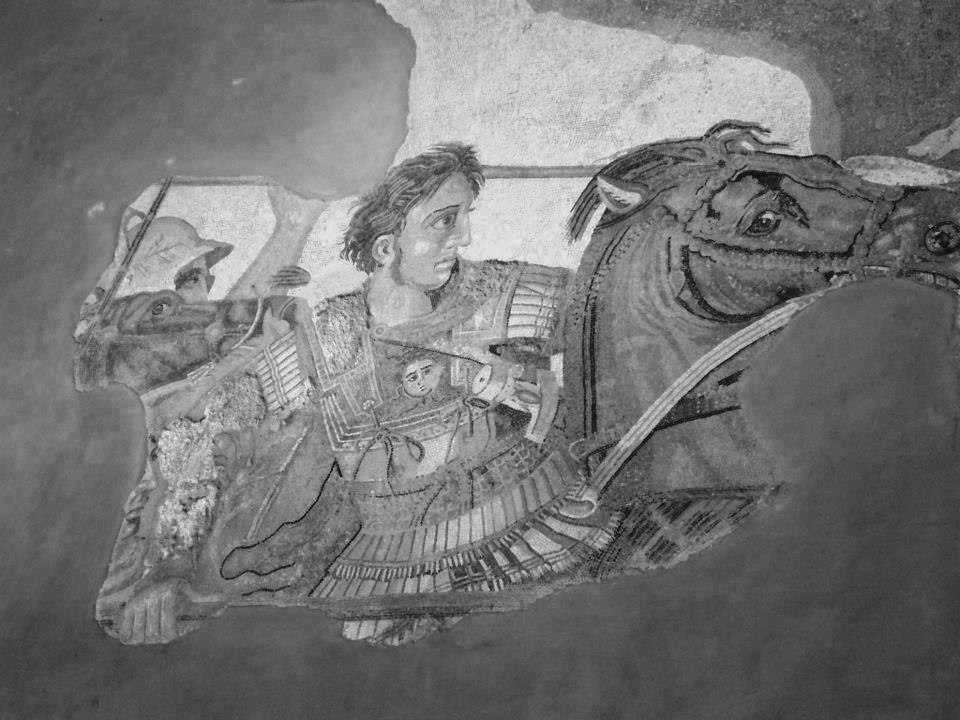
“Alexander was, as few other monarchs have ever been, a specially educated king; he was educated for empire. Aristotle was but one of the several able tutors his father chose for him. Philip confided his policy to him, and entrusted him with commands and authority by the time he was sixteen. He commanded the cavalry at Chaeronea under his father’s eye. He was nursed into power – generously and unsuspiciously. To any one who reads his life with care it is evident that Alexander started with an equipment of training and ideas of unprecedented value.

“The strong sanity he inherited from his father had made him a great soldier; the teaching of Aristotle had given him something of the scientific outlook upon the world. He had destroyed Tyre; in Egypt, at one of the mouths of the Nile, he now founded a new city, Alexandria, to replace that ancient centre of trade. To the north of Tyre, near Issus, he founded a second port, Alexandretta. Both of these cities flourish to this day, and for a time Alexandria was perhaps the greatest city in the world.

“…he was forming no group of statesmen about him; he was thinking of no successor; he was creating no tradition – nothing more than a personal legend. The idea that the world would have to go on after Alexander, engaged in any other employment than the discussion of his magnificence, seems to have been outside his mental range. He was still young, it is true, but well before Philip was one and thirty he had been thinking of the education of Alexander.

“We are too apt to consider the career of Alexander as the crown of some process that had long been afoot; as the climax of a crescendo. In a sense, no doubt, it was that; but much more true is it that it was not so much an end as a beginning; it was the first revelation to the human imagination of the oneness of human affairs. The utmost reach of the thought of Greece before his time was of a Persian empire Hellenized, a predominance in the world of Macedonians and Greeks. But before Alexander was dead, and much more after he was dead and there had been time to think him over, the conception of a world law and organization was a practicable and assimilable idea for the minds of men.

“For some generations Alexander the Great was for mankind the symbol and embodiment of world order and world dominion. He became a fabulous being. His head, adorned with the divine symbols of the demi-god Hercules or the god Ammon Ra, appears on the coins of such among his successors as could claim to be his heirs. Then the idea of world dominion was taken up by another great people, a people who for some centuries exhibited considerable political genius, the Romans; and the figure of another conspicuous adventurer, Caesar, eclipsed for the western half of the old world the figure of Alexander.

*All excerpts have been taken from The Outline of History, Norwood Press.

Two Causes which Destroyed Rome – Baron de Montesquieu

Synopsis:

The eighteenth century political philosopher Montesquieu examines the constituent features of Roman culture which contributed to the collapse of the Roman Republic. Montesquieu argues that the increasing territorial, as well as material grandeur of the Roman Republic magnified already existing constitutional schisms, and the primal bellicosity of the Roman people lingered as a tinderbox for civil strife long after external conflicts had ended.

Excerpts:

“The reason why free states are not so permanent as other forms of government, is, because the misfortunes and successes which happen to them, generally occasion the loss of liberty; whereas the successes and misfortunes of an arbitrary government, contribute equally to the enslaving of the people.

“Authors enlarge very copiously on the divisions which proved the destruction of Rome; but their readers seldom discover those divisions to have been always necessary and inevitable. The grandeur of the republic was the only source of that calamity, and exasperated popular tumults into civil wars. Dissensions were not to be prevented, and those martial spirits, which were so fierce and formidable abroad, could not be habituated to any considerable moderation at home.

“Those who expect in a free state, to see the people undaunted in war and pusillanimous in peace, are certainly desirous of impossibilities; and it may be advanced as a general rule, that whenever a perfect calm is visible, in a state that calls itself a republic, the spirit of liberty no longer subsists.

“It must be acknowledged that the Roman laws were too weak to govern the republic: but experience has proved it to be an invariable fact, that good laws, which raise the reputation and power of a small republic, become incommodious to it, when once its grandeur is established, because it was their natural effect to make a great people, but not to govern them.

“Rome was founded for grandeur, and its laws had an admirable tendency to bestow it; for which reason, in all the variations of her government, whether monarchy, aristocracy, or popular, she constantly engaged in enterprises which required conduct to accomplish them, and always succeeded. The experience of a day did not furnish her with more wisdom than all other nations, but she obtained it by a long succession of events. She sustained a small, a moderate, and an immense fortune with the same superiority, derived true welfare from the whole train of her prosperity, and refined every instance of calamity into beneficial instructions… She lost her liberty, because she completed her work too soon.

*All excerpts have been taken from Considerations on the Causes of the Grandeur and Declension of the Roman Empire, Public Domain.

Lycurgus of Sparta – Plutarch

Synopsis:

The life of Lycurgus the lawgiver of Sparta is mostly legendary in character – and Plutarch admits this much in his biography of him. Accordingly, Plutarch dedicates much of his biography of Lycurgus to the Spartan city-state and the constitution which Lycurgus created. In this way, Plutarch keenly balances the mythical context with his own reflections on the enduring institutions which Lycurgus devised.

Excerpts:

“The Egyptians say that he took a voyage into Egypt, and that, being much taken with their way of separating the soldiery from the rest of the nation, he transferred it from them to Sparta, a removal from contact with those employed in low and mechanical occupations giving high refinement and beauty to the state.

“Amongst the many changes and alterations which Lycurgus made, the first and of greatest importance was the establishment of the senate, which having a power equal to the king’s in matters of great consequence, and, as Plato expresses it, allaying and qualifying the fiery genius of the royal office, gave steadiness and safety to the commonwealth.

“A third ordinance of Rhetra was, that they should not make war often, or long, with the same enemy, lest that they should train and instruct them in war, by habituating them to defend themselves.

“The senate, as I said before, consisted of those who were Lycurgus’s chief aiders and assistants in his plans. The vacancies he ordered to be supplied out of the best and most deserving men past sixty years old.

“Aristocrates, the son of Hipparchus, says that he died in Crete, and that his Cretan friends, in accordance with his own request, when they had burned his body, scattered the ashes into the sea; for fear lest, if his relics should be transported to Lacedaemon, the people might pretend to be released from their oaths, and make innovations in the government.

*All excerpts have been taken from Plutarch’s Lives – Vol. I, Modern Library.

Theodosius and the Antibarbarian Reaction – Alessandro Barbero

Synopsis:

The Battle of Adrianople in 378 often signals a key crossroad in the history of the late Roman Empire, but Alessandro Barbero lays out a somewhat different narrative in his book The Day of the Barbarians. Barbero examines the event within a three century context, and chronicles the cultural evolution of Roman civilization leading up to the battle – as well as the civilizational reaction following the final peace agreement with the Goths. As Roman power began to decline in the fifth century, the long ignored aristocracy of Rome began to reassert itself by becoming the foremost voice of the anti-barbarian reaction.

Excerpts:

“In the dissatisfaction that the Greek East felt at the political and military hegemony of the Latin West lay the seeds of competition – if not hostility – between the two parts of the Roman Empire; those seeds would not fail to produce fruit.

“All the rhetoric about the universality of the empire, about its capacity for assimilation, was trotted out to demonstrate that Theodosius had made the right choice. And, to be clear, it wasn’t all empty rhetoric; to a certain degree, that capacity for assimilation genuinely existed.

“The army, which was a community, seemed like the perfect machine for handling this integration process. It absorbed barbarians, ground them down, and transformed them into Roman veterans, into the men whom emperors in their public discourses addressed as ‘comrades in arms’ and who constituted the real pillar of the empire.

“In certain regions of the empire, where the mercenaries had completely replaced the units of the regular army, the change was reflected in the language itself: In Syriac, starting at the end of the fourth century, the word for ‘soldier’ became Goth.

“Most people ultimately shared the assumptions about the empire’s ability to assimilate the barbarians but resisted granting them too much power too quickly and thereby abdicating the civilizing mission of the empire.

*All excerpts have been taken from The Day of the Barbarians: The Battle That Led to the Fall of the Roman Empire, Walker & Company.

Julius Caesar – Plutarch

Synopsis:

Plutarch’s biography of Julius Caesar examines the moral, and intellectual dimensions of Caesar’s character. Context is a pronounced component of Plutarch’s analysis – which utilizes the underlying Roman political culture of the era as a bedrock feature of the narrative. Further, Plutarch uses biographical anecdotes to advance an image of Caesar as a world historical individual. 

Excerpts:

“Sulla, without openly objecting, took measures to see that he was not elected and discussed the question of whether or not to have him put to death. When some of his advisers said that there was no point in killing a boy like him, Sulla replied that they must be lacking in intelligence if they did not see that in this boy there were many Mariuses.

“Cicero, who is thought to have been the first to have seen beneath the surface of Caesar’s political program and to have feared it as one might fear the smiling surface of the sea, and who understood how powerful a character was hidden behind Caesar’s agreeable, good-humored manners, said that, in general, he could detect in everything that Caesar planned or undertook in politics a purpose that was aiming at absolute power.

“For the cause of the civil wars was not, as most people think, the quarrel between Caesar and Pompey; it was rather their friendship, since in the first place they worked together to destroy the power of the aristocracy and only when this had been accomplished quarreled amongst themselves.

“For when Pompey, for some reason or other (possibly over caution), instead of putting the finishing stroke to his great success, retired as soon as he had driven the routed enemy inside their camp, Caesar, who was with his friends, remarked to them as he was leaving them: ‘Today the enemy would have won , if they had a commander who was a winner.’

“Brutus fancied that he heard a noise at the entrance to the tent and, looking towards the light of the lamp which was almost out, he saw a terrible figure, like a man, though unnaturally large and with a very severe expression. He was frightened at first, but, finding that this apparition just stood silently by his bed without doing or saying anything, he said: ‘Who are you?’ Then the phantom replied: ‘Brutus, I am your evil genius. You shall see me at Philippi.

*All excerpts have been taken from Fall of the Roman Republic, Penguin Books.